_edited.png)


From Grief to Grace: The Birth of Newark Pride
- Newark Pride
- Apr 30
- 3 min read

In 2003, Sakia Gunn, a 15-year-old Black lesbian from Newark, was killed after rejecting the advances of 29-year-old Richard McCullough at a downtown Newark bus stop. She and her friends had just returned home on the PATH train from Greenwich Village in the early morning hours when the men approached and propositioned them. When Sakia told them she was gay, one of the men stabbed her and drove off, leaving her to die on the street just blocks from Newark City Hall. She was 15 years old. Her life was taken in an act of violence rooted in homophobia and misogyny, something too many in our community still face.
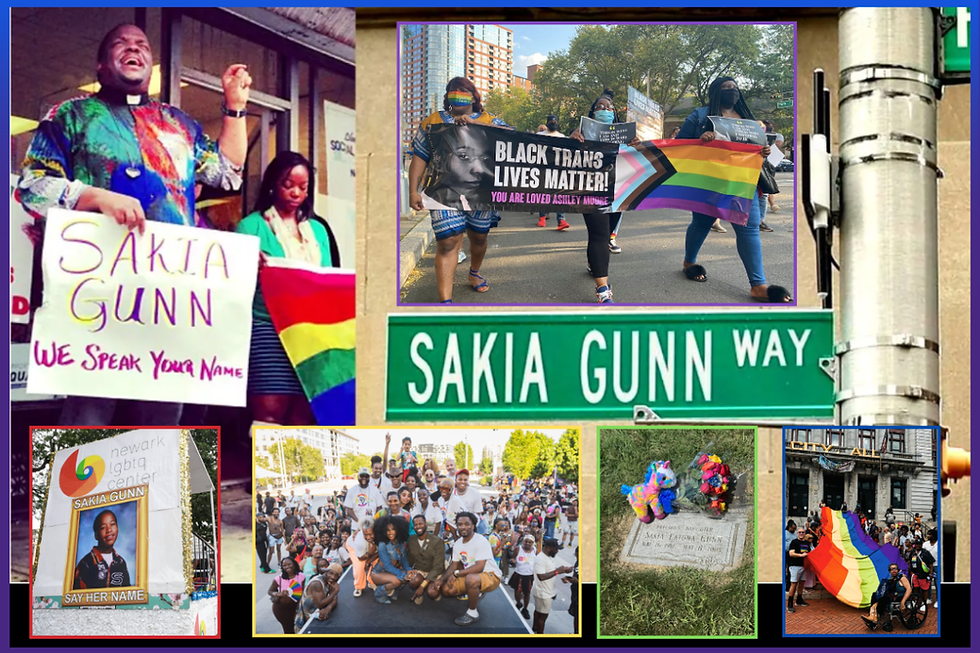
Sakia’s friends and classmates swarmed the streets as the news broke, prompting a city-wide response from community leaders and organizations. As her best friend Dawn James and a host of other teenagers searched for safe space to grieve, Rev. Jae Quinlan opened up her backyard for what could essentially be regarded as the first “pride cookout” in Sakia’s honor.
Her story does not begin or end with tragedy; her story has become about visibility, truth, and the urgency of protecting Black LGBTQIA+ youth. It is also the story of how Newark Pride was born, and why it is celebrated every July.
For Newark Pride founder June Dowell-Burton, Sakia’s death was a heartbreaking wake-up call. It forced a painful confrontation with the truth that Black LGBTQIA+ people in Newark were too often left vulnerable, unseen, and unprotected. She could not accept that Sakia’s life would be reduced to another tragedy, another headline, another name spoken only in grief. In 2005, along with founding member of Newark Pride Alliance James Credle, founder of the Newark LGBTQ Community Center Rev. Janyce Jackson, Rev. Jae Quinlan of L.I.T. Church and many others, Dowell-Burton helped create something in response: the Newark-Essex Pride Week.
Most Pride celebrations across the country are held in June, commemorating the Stonewall Riots of June 1969. In 2012, as June became oversaturated with Pride activations that led to a wellspring of corporate marketing campaigns, Newark made a different and deliberate choice to establish the second week of July as our week of remembrance. By holding Newark Pride Week in July, Newark’s LGBTQIA+ community declared that its celebration would be rooted in its own history, its own loss, and its own story of resistance. July is Newark’s month. It belongs to Sakia, to the community that mourned her, to the activists who refused to let her death be forgotten, and to every Black and Brown LGBTQIA+ person in this city who deserved to see themselves centered in their own celebration. It is a declaration that Newark’s Pride was built here, from grief and love and fury, by and for the people of this city.
Newark Pride was founded on the belief that our community deserved more visibility, safety, and a space where our lives, our voices, and our joy would be honored openly and unapologetically. What was born from pain became a commitment to action and a promise to build something lasting in this city – something that affirmed who we are and demanded that others see our humanity.
For Newark, Sakia's name is remembered and repeated each year as we gather, volunteer, advocate, and celebrate in her honor. Our July Pride is a conscious declaration that this City’s LGBTQIA+ community has its own story, its own grief, and its own defiant joy.
We carry the weight of those who did not get to grow older, louder, or freer. Newark Pride is about expression, survival, advocacy, resistance, remembrance, and joy. Sakia’s legacy remains part of our foundation. Her memory continues to push us to speak louder, stand taller, and fight harder for a Newark where LGBTQIA+ people, especially Black and Brown youth, can live boldly and freely.
The volunteers of Newark Pride will continue to say her name to affirm that her life, identity, and presence, like so many others, will never be erased.
Comments